
Don't be surprised if you find yourself facing hedgehog ear infections with your little ouch mouse. Let's face it. Hedgehogs can be a little quirky at times. So some of their strange behaviors seem…well…normal (for a hedgehog at least). One day you may notice that they're periodically shaking their heads (like a dog out of a bath). And then, before you know it, they have stuff oozing out of their ears.
If you've been there before, you know what we mean. If your quill baby has never experienced hedgehog ear infections, we'll be covering everything from symptoms, diagnostic methods, and typical treatments for the different types of infections.
AFFILIATE DISCLOSURE: Heavenly Hedgies is an Amazon Associate. We have partnered with them and other reputable merchants when they sell something that we feel will benefit our readers. By purchasing through our links, we may earn a small commission on sales, that helps us continue to provide informative and educational information for hedgie lovers. And the best part is that there is no additional cost to you. Thank you for being a loyal and supportive reader here at Heavenly Hedgies.
Symptoms OF Hedgehog Ear Infections
Even though your hedgie may be eating, drinking, and pooping normally, it's entirely possible they could have an infection that hasn't gotten severe enough to be apparent yet. Worse even, some early indicators of an ear infection could be a symptom of some illness that is totally different. We've beat this drum before, and we're going to beat it again. An inexpensive wi-fi night camera can be a real live saver in some instances. In other instances it can help you see early warning signs that signal you to get your quill baby to the vet sooner as opposed to later. The more severe an illness gets, the more costly it is to treat…including hedgehog ear infections. Please take our advice and invest in a early detection camera for the sake of your hedgie and your wallet!

If you see your hedgehog scratching at their ear(s), it could simply be dry skin. BUT, it could also be an early sign of a hedgie ear infection instead. Some subtle things can actually signal infection -or- nothing medically significant. If you observe any of the following, take note!
- Ears that appear to have tattered edges
- Shaking their head (like a dog does after a bath)
- Scratching at their ears
- Walking in circles
- Leaning to one side
- Unable to walk (or run) a straight line
- Balance issues
Any or all of these could be telling you that your hedgehog needs treatment. While these could be signs of an ear infection, they could also be something different. We recommend that you have your hedgie seen by a qualified exotic vet to determine exactly what's going on.
Diagnostic Methods For Hedgehog Ear Infections
Here are some tips to help prepare you for your vet visit. Many vets will use a combination of methods to arrive at a diagnosis. Every vet visit begins with a discussion regarding your observations. When we said take note earlier, we literally meant it. Writing things down as you observe them helps you discuss what you see happening. It may be diagnostically significant! In a short office visit, your hedgie may not exhibit all the symptoms that may only occur intermittently.
Next they'll do a visual inspection of your hedgehog. If your hedgehog is particularly huffy and won't cooperate with a physical exam, don't be surprised if the doctor gives them a shot to calm them or even gas to put them to sleep. If they suspect any type of hedgehog ear infections, they'll examine the outer ear first. They'll note any visual abnormalities like tattered ears, flakiness, crustiness, discharge, or a pain reaction. They may even take a sniff near the ear to smell for possible foul odors.
Depending on the vet's observations, they may perform some diagnostic lab work. Often they will want to do an ear culture if there is any kind of discharge. Usually an x-ray of the skull isn't taken unless they are trying to determine whether there is a deeper ear infection into the middle or inner ear.
Types of hedgehog ear infections
There are several categories of hedgehog ear infections that can occur. Depending on the type of infection, each has their own course of treatment. Below we share the most common types of hedgie ear infections and what the vet may recommend.
Ear Mite Infection

Tattered or ragged ears are often seen on hedgehogs that have an ear mite infection. Ear mites - if left untreated - can cause secondary bacterial infections. Additionally, as seen in the above picture of her rescue hog (graciously shared by Kirbee Porter), a persistent case can leave the ears disfigured.
Commonly, the treatment for a parasitic hedgehog ear infection may include ear drops that consist of a combination of Neomycin + Permethrin. It is important that you seek treatment from a vet for this illness.
Fungal Infection On A Hedgehog's Ear
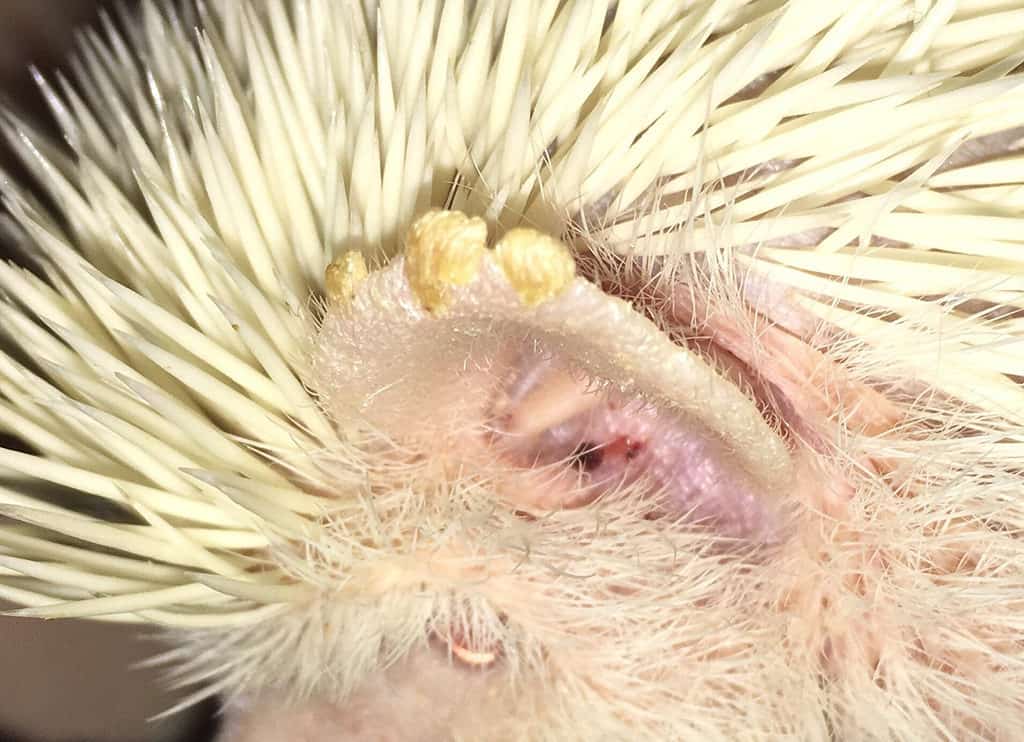
Another type of hedgehog ear infection that commonly exhibits tattered ears is a fungal infection. Ear fungus - visually looks like little gray or cream “fingers” growing around the edges as shown in the picture above. It is most often found when wood shavings or paper products are used for bedding. High air moisture increases fungal growth. And, if this goes untreated, it will literally eat the ears away to nubs. Another common type of fungal infection that can infect a hedgehog's ears is ringworm.
Veterinary treatment for these type of infections may include Clortimazole drops applied topically or some other prescription fungicide (like Panalog which is an antibiotic/anti fungal cream) applied twice a day until the fungus falls off of the ear. Some hedgie owners who live great distances from a qualified exotic vet have successfully used athlete's foot cream on mild beginning cases of ear fungus. While we do not encourage avoidance of proper veterinary care, we also don't advocate doing nothing due to a lack of resources.
Middle or Inner Ear Infection
Thanks to Alissha Rutherford for sharing her picture of her hedgehog's oozing ear Thanks to Christy Clardy for sharing her picture of her hedgehog's infected ear
A hedgehog that has a middle or inner ear infection will often have discharge that oozes from the ear. This type of ear infection is unlike the others that have early tell-tale signs evident on the outer ear. With careful observation, it can often be caught by watching your hedgehog's behaviors. An inner or middle ear infection almost always affects a hedgie's balance. They may go in circles like their steering is broken. They may wobble as they stand or walk. Or, they may even experience vertigo. Their balance is almost always affected in some way.
Final Thoughts On Hedgehog Ear Infections
We've looked at the most common causes of hedgehog ear infections and explored some early warning signs for you to watch for. As hedgie parents, it's always upsetting when your lap cactuses aren't feeling well. Some hedgie parents may even feel like they've somehow failed. This line of thought isn't healthy for the hedgehog owner and certainly won't help the hedgie.
With observation of what your hedgie's normal behaviors are, it'll be easier to spot abnormal behaviors. This is one of the many reasons why a wifi camera can be your biggest ally. Think of it as your own personal hedgie-sitter! If your hedgie exhibits any signs that are abnormal, we encourage you to be proactive and make an appointment with their vet before it progresses. If you do find out they have one of the many hedgehog ear infections, please complete the full course of treatment your veterinarian prescribes. And Quilly says, “Don't forget to give extra cuddles and wurmiez!”